
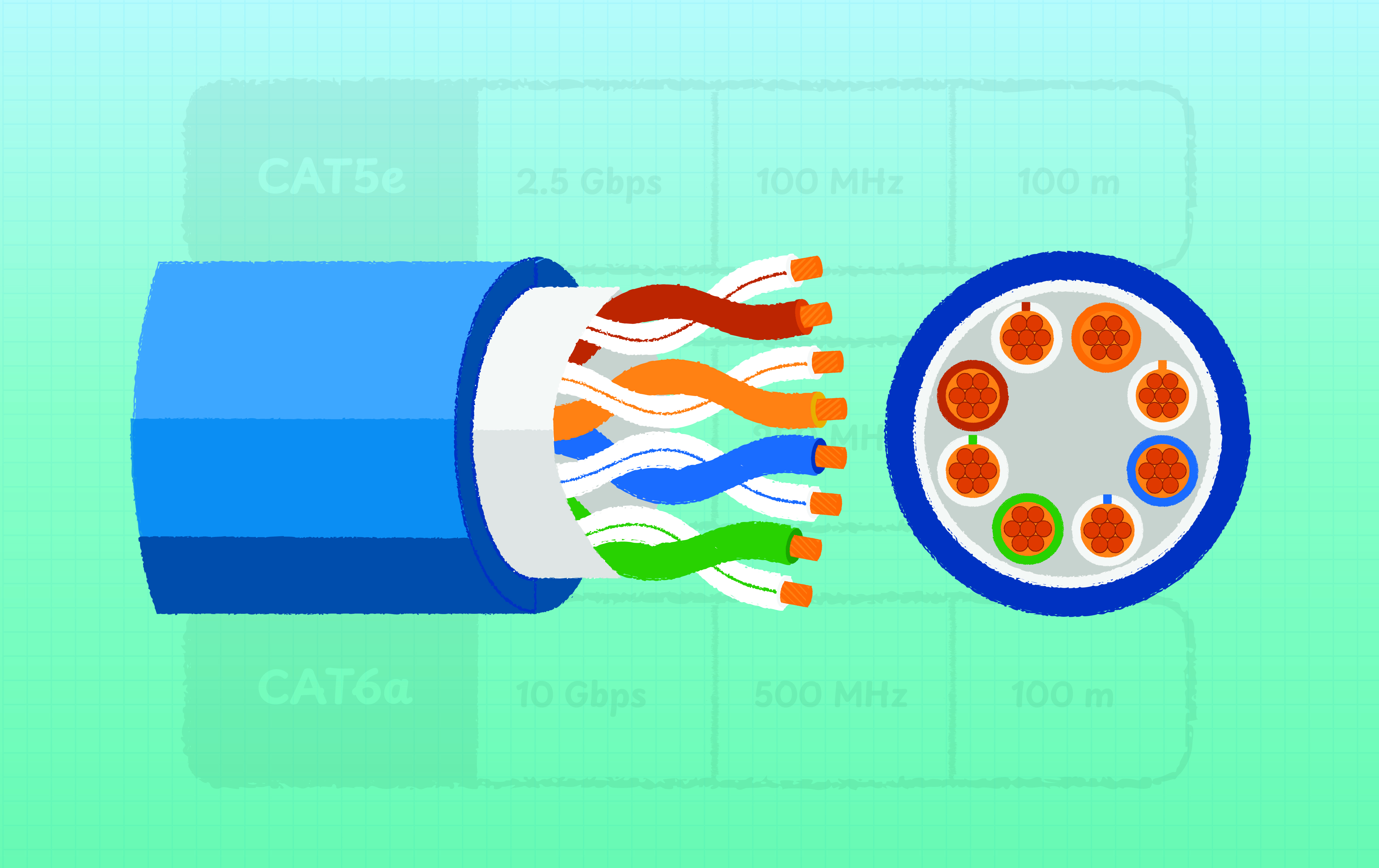
There existed a time where CAT5e and CAT6 cabling was installed, officially supporting up to 1Gbps over 100m lengths. However, as networking needs increased, it was found that with the correct magnetics and terminations, these older installations could handle far greater speeds. In this article, we will look at these older installations, the challenges with replacing them, and how their operational life can be extended when paired with Bel ICMs.
Why CAT5e and CAT6 Cabling Still Dominate Network Infrastructure
Ethernet cabling is one of the most fundamental elements of modern network infrastructure, forming the backbone of enterprise, industrial, and commercial systems. Made using twisted copper pairs terminated via RJ45 connectors, these cables and connectors provide strong noise immunity, stable differential signalling, and reliable common-mode rejection over long distances.
Despite the crucial nature of Ethernet cabling, a large proportion of installed networks today still rely on older CAT5e and CAT6 cabling. These installations, originally deployed with 1Gbps operation in mind, worked well for many years. However, network demand has steadily increased, driven by high-density wireless access points, cloud services, IP surveillance systems, industrial automation, and distributed edge computing.
While upgrading active networking equipment is relatively straightforward, replacing structured cabling is anything but. In many environments, replacing cables is expensive, often disruptive, and an operational nightmare. The end result is that electronics evolve much faster than the physical infrastructure they are installed in, leaving many networks constrained by their installed base.
With these challenges in mind, organizations are now increasingly looking for ways to extend the usable life of existing CAT5e and CAT6 cabling while increasing overall network throughput without full-scale infrastructure replacement.
Network Performance Bottlenecks: Why the Weakest Link Limits Throughput
No Ethernet network is defined by a single component, but instead, as a complete system composed of switches, PHYs, magnetics, connectors, cabling, and endpoint devices. And because data must pass through every element in the chain, the overall performance is always limited by the weakest link. This is a fundamental constraint in real-world networking.
This interdependency between all system components creates a major challenge for engineers during infrastructure upgrades, as replacing just a single component in a network is rarely possible. Because of this, improvements often require coordinated changes across multiple layers of the network stack.
For many organizations, network cabling represents the single most expensive and disruptive part of an installation. Because these cables are often embedded into buildings, production facilities, and service infrastructure, replacing them is both costly and operationally complex.
CAT5e vs CAT6 vs CAT6a: Bandwidth Limits and Upgrade Challenges
While now mostly outdated, CAT5e and CAT6 cabling played a critical role in the expansion of gigabit networking and is still commonly found. CAT5e, standardized in the late 1990s, enabled reliable 1Gbps operation over 100 meters, while CAT6 followed with improved electrical performance, tighter specifications, and support for higher signalling margins. It also enabled 10Gbps operation over shorter distances while maintaining 1Gbps support over the full 100m length.
However, the rapid growth of cloud computing, wireless networking, IP surveillance, industrial automation, and connected devices quickly increased demand for greater network throughput. To address this requirement, CAT6a was introduced, extending 10Gbps operation to the full 100-meter distance.
| Cable Type | Standardized | Max Speed | Max Distance | Physical Characteristics | Relative Cost |
|---|---|---|---|---|---|
| CAT5e | Late 1990s | 1Gbps | 100m | Thin, flexible, easy to install | Low |
| CAT6 | Early 2000s | 1Gbps (10Gbps short-range) | 100m (1Gbps) / ~55m (10Gbps) | Slightly thicker than CAT5e, tighter tolerances | Low–Moderate |
| CAT6a | Mid-2000s | 10Gbps | 100m | Larger, more rigid, harder to install | Higher |
Table: Ethernet Cable Category Comparison (CAT5e vs. CAT6 vs. CAT6a)
While CAT6a delivered the performance needed for next-generation networking, it also introduced new challenges. Compared to CAT5e and CAT6, CAT6a is physically larger, more rigid, and generally more expensive to install. During its initial release, new installations could address these compromises, but for many existing facilities, the cost and disruption associated with switching to CAT6a was not easily justified.
As a result, many organizations continued deploying CAT5e and CAT6 infrastructure, creating a substantial installed base that remains in operation today, but now leaves these installations in a strange networking purgatory.
The Continued Viability of Intermediate Ethernet Speeds
Because ethernet technologies have historically increased by a factor of ten on each new release (10mbps, 100mbps, and 1Gbps), the next speed category is 10Gbps, something which CAT5e and CAT6 cannot support over 100meters. However, many applications do not require a full jump to 10Gbps, instead, being perfectly capable of operating at slightly elevated speeds of 2.5Gbps or 5Gbps.
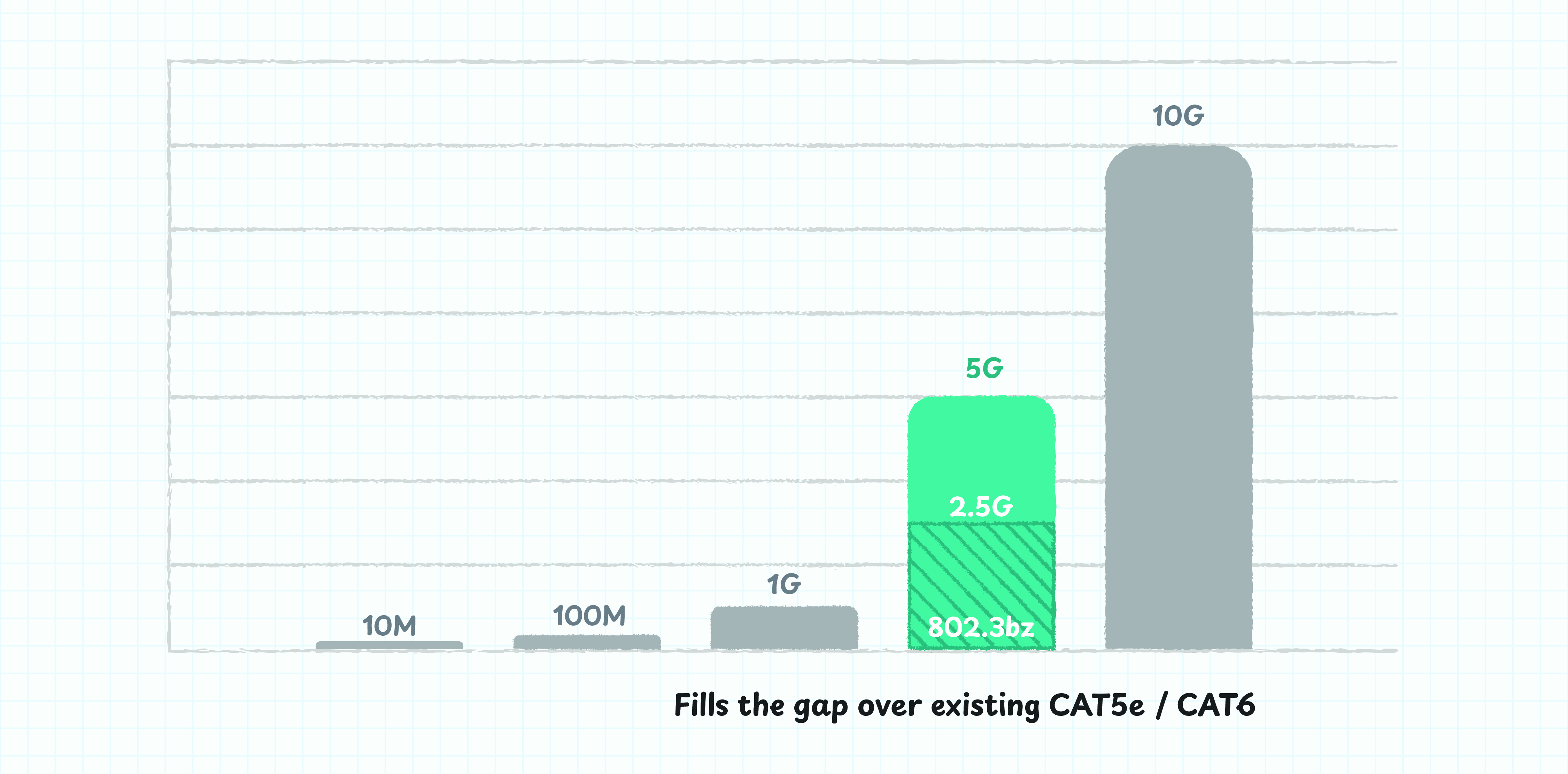
If these slightly elevated speeds can be utilised, the ability to achieve these higher data rates while continuing to leverage existing CAT5e and CAT6 infrastructure thus becomes highly desirable, both from a technical and economic perspective.
This ultimately created the need for an intermediate solution between traditional Gigabit Ethernet and full 10Gbps networking.
Top Use Cases for 2.5G/5G Ethernet
During era of CAT5e and CAT6 cable, IT infrastructure was starting to see major changes and advances, especially in enterprise, office, and industrial applications. Several sectors are independently converging on the same need — a bandwidth upgrade path that doesn't require ripping out structured cabling:
- Enterprise Wi-Fi (Wi-Fi 6/6E): Modern access points can exceed 1Gbps uplink capacity in dense environments with many simultaneous users, and mesh networks without a higher-speed wired backend see this bottleneck hit performance directly.
- Large office deployments: These environments already contain extensive CAT5e/CAT6 cabling, and replacing it solely to raise uplink bandwidth is rarely justified given the cost and disruption involved.
- Industrial networks & IoT: Upgrading hardware here is especially complex, since manufacturing environments need near-continuous uptime, making cable replacement difficult to schedule without interfering with production.
- IP surveillance systems: Rising camera resolutions, frame rates, and camera counts are driving aggregate traffic that can rapidly exceed traditional 1Gbps uplink capacity.
Across all of these sectors, the common requirement is clear: a practical upgrade path between 1Gbps and 10Gbps that does not require replacing existing structured cabling.
Understanding IEEE 802.3bz and the Evolution of Multi-Gigabit Ethernet
Recognizing the need to provide a new speed band that could accommodate these elevated needs over older cable, the NBASE-T Alliance proposed an intermediate solution which eventually became the IEEE 802.3bz standard. This standard defined two new speed categories; 2.5GBASE-T and 5GBASE-T.
The standard emerged from the observation that a large installed base of CAT5e and CAT6 cabling still contained sufficient electrical performance margin to support higher data rates than originally specified.
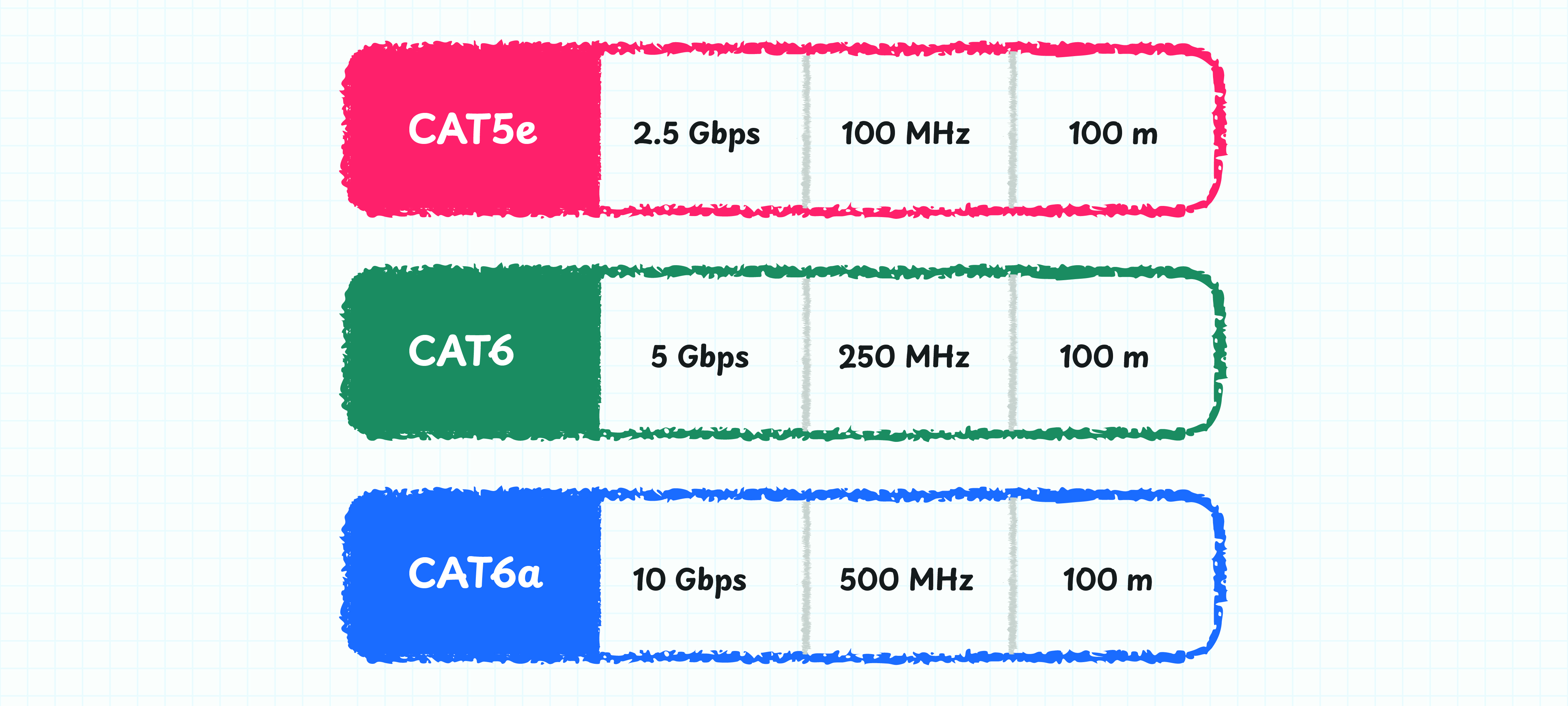
It should be noted that this margin is not guaranteed and depends heavily on installation quality, cable length, and environmental conditions. As a result, existing cabling should always be re-qualified before being used for multi-gigabit operation.
The Role of the PHY in Multi-Gigabit Performance
However, actually achieving 2.5Gbps and 5Gbps over legacy cabling is not a simple matter of increasing signal frequency. Instead, it requires all aspects of the link to be carefully matched and controlled, including using modern PHY devices capable of advanced digital signal processing techniques including adaptive equalization, echo cancellation, and noise mitigation.
These techniques allow the PHY to reconstruct data from imperfect transmission channels, compensating for attenuation, reflection, and interference. Thus, this makes the PHY a critical determinant of achievable network performance.
But equally important is the interaction between the PHY, magnetics, connector system, and installed cabling. All of these components form a tightly coupled electrical system, where small variations in one element can significantly affect overall link stability and performance.
Integrated Connector Modules (ICMs) for Multi-Gigabit Ethernet
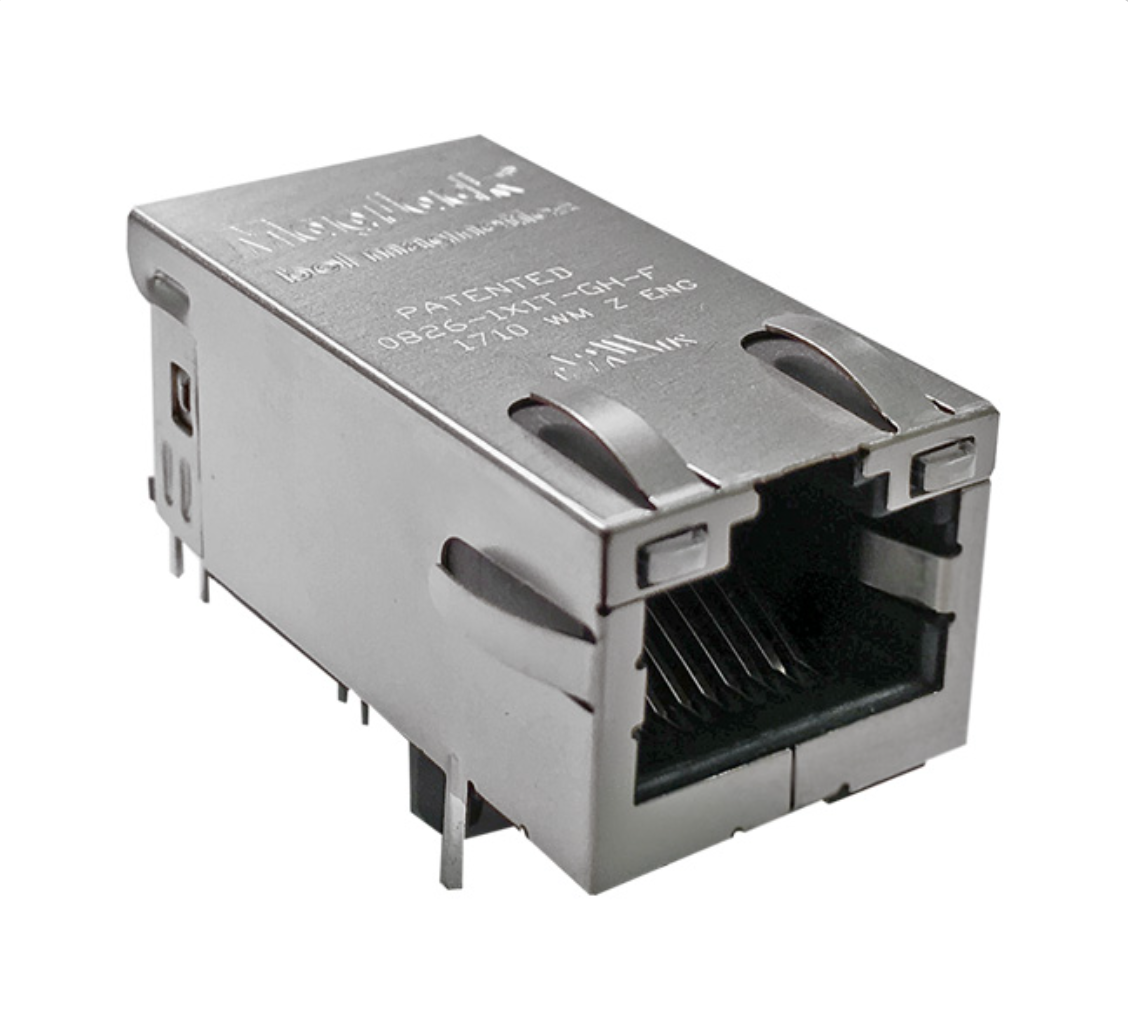
To support reliable multi-gigabit Ethernet over existing CAT5e and CAT6 infrastructure, Bel has developed Integrated Connector Modules (ICMs) designed specifically for 2.5Gbps and 5Gbps operation.
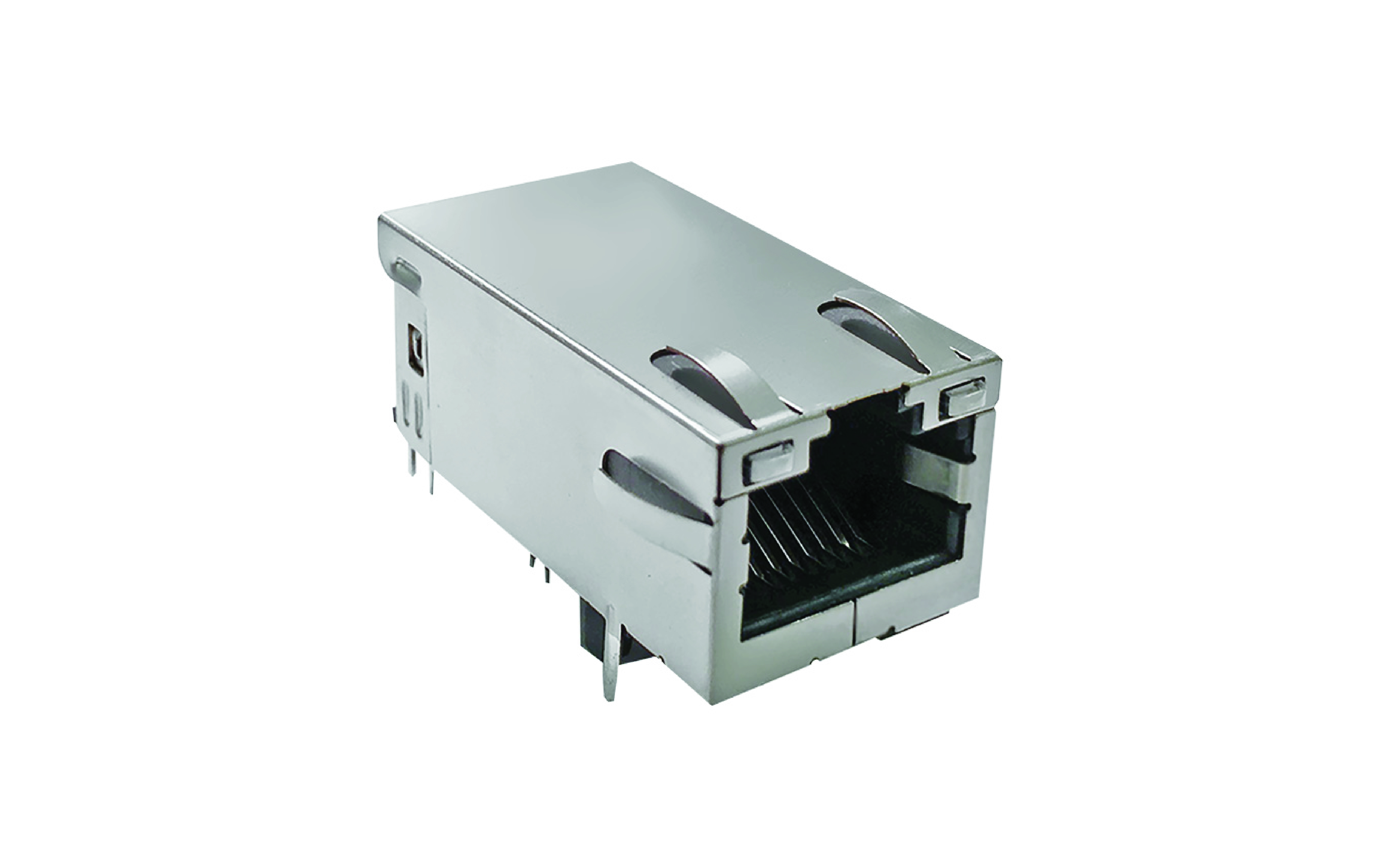
These ICMs utilize carefully engineered magnetic structures paired with specific PHYs that optimize signal integrity across the full frequency range required for multi-gigabit transmission. To achieve this capability Bel has focused on minimizing common-mode noise while maintaining stable impedance matching across all operating conditions, as even small improvements in magnetics can have a very real impact on overall link performance.
The Importance of Validated PHY Partnerships
Bel worked closely with leading PHY manufacturers, including Broadcom and Marvell, to validate the performance of the new ICMs against specific silicon implementations. By doing so, the interaction between PHY and magnetics is fully characterized and optimized as a complete system rather than as isolated components.
These validated combinations, often included in PHY vendor reference designs, give system designers access to pre-qualified hardware configurations that not only reduce development risk, but also accelerate time to market. As such, instead of relying on untested PHY and connector combinations, OEMs can implement known-good configurations that have already been validated for interoperability and performance.
Power over Ethernet (PoE) and Multi-Gigabit Signal Integrity
Another emerging trend in network infrastructure is the need to also require Power over Ethernet functionality, adding another layer of complexity to system design. Delivering power and multi-gigabit data over the same cable introduces compounding design challenges:
- Thermal management: Higher current flow through cable and magnetics generates additional heat, which must be managed for long-term reliability.
- Signal integrity under load: Data signals must stay clean even with power running across the same conductors.
- Isolation & transformer design: PoE raises the bar on isolation and magnetic performance to prevent power transmission from degrading data transmission.
Thus, in applications needing PoE capabilities, magnetics design becomes even more critical. Bel’s ICM solutions are designed to support both multi-gigabit Ethernet and PoE applications, ensuring stable operation across a wide range of deployment scenarios.
Extending CAT5e/CAT6 Life with 2.5G/5G Ethernet: Key Takeaways
CAT5e and CAT6 cabling remain a foundational part of global network infrastructure. While originally designed for 1Gbps operation, these systems continue to support a large proportion of enterprise, commercial, and industrial deployments.
As application demand increases, many of these networks now require higher bandwidth, but replacing structured cabling is often costly, disruptive, and operationally impractical.
IEEE 802.3bz provides engineers with a practical solution by enabling 2.5Gbps and 5Gbps Ethernet over properly qualified existing infrastructure, bridging the gap between legacy 1Gbps systems and full 10Gbps upgrades. However, achieving reliable performance depends on more than just the cable, requiring correctly matched PHYs, magnetics, and connectors.
Through close collaboration with PHY vendors such as Broadcom and Marvell, Bel has developed validated Integrated Connector Module solutions that enable reliable multi-gigabit Ethernet over CAT5e and CAT6 infrastructure.
For organizations seeking to extend the life of existing cabling while improving network performance, these solutions provide a practical and scalable path between 1Gbps and 10Gbps Ethernet.


.png)