10GBASE-T SFP+ copper transceivers form a key network technology across datacenters, industrial installations, and commercial systems, but historically, 10GBASE-T SFP+ copper transceivers using CAT6a cables have been limited to 30 meters. Now, thanks to improvements in technology and a better understanding of fundamental limitations, Bel can extend 10Gbps over 100 meters using CAT6a, opening up new opportunities. But getting there is no small feat, so in this article we will cover why going beyond 30 meters introduces serious challenges, why going beyond this limitation is nonetheless essential for certain infrastructure, and how Bel achieved the 100 meter milestone.
Why CAT6a Networks Have Been Stuck at 30 Meters
Despite the rapid pace of technological advancements, infrastructure upgrades, and the constant push to integrate the latest technologies, a significant portion of today's commercial, enterprise, and industrial networks were installed many years ago. During the installation of these older systems, CAT6a became one of the most widely adopted cabling standards due to its ability to support 10Gbps Ethernet connections over distances of up to 100 meters.
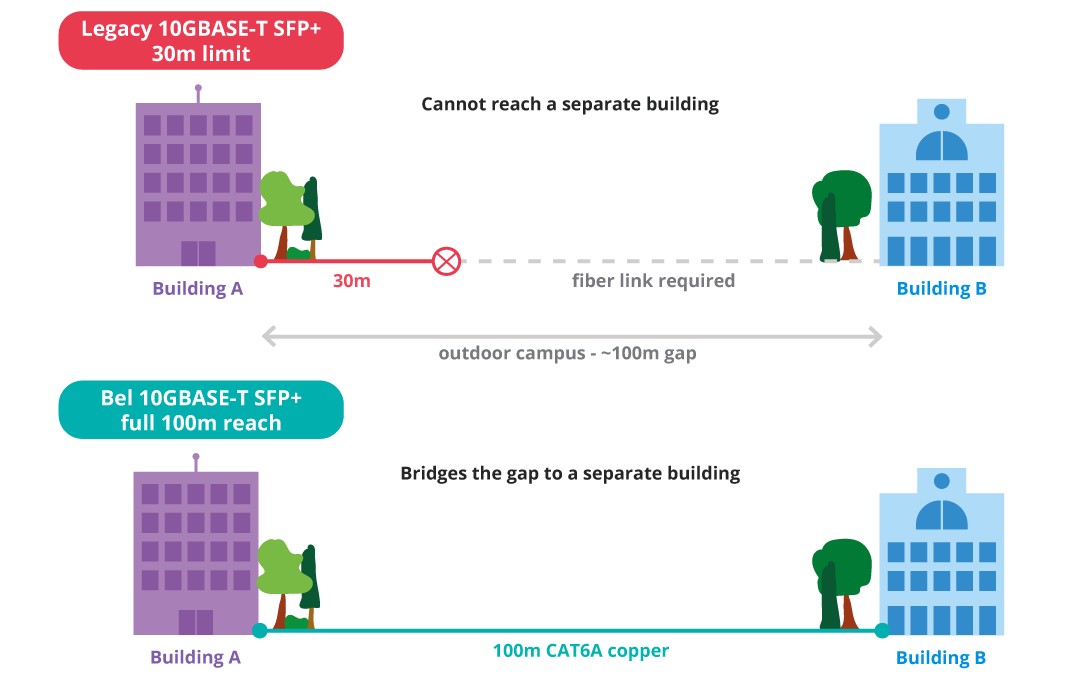
However, as networking equipment evolved, many enterprise systems moved away from fixed RJ45 ports and towards modular SFP+ architectures. While this shift to modular ports increased flexibility and simplified maintenance, it also introduced an unexpected limitation; delivering 10Gbps over CAT6a using 10GBASE-T SFP+ transceivers was capped to approximately 30 meters.
Because of this limitation, network designers have been forced into an uncomfortable choice between three options:
- Reduce cable lengths to stay within the 30-meter SFP+ limit
- Accept lower bandwidths on longer cable runs
- Replace existing copper infrastructure with more expensive fiber solutions
But if CAT6a was specifically designed to support 10Gbps over 100 meters, why does moving from a fixed RJ45 port to an SFP+ transceiver suddenly reduce that distance by 70%?
10GBASE-T vs. 10GBASE-T SFP+: Key Differences Explained
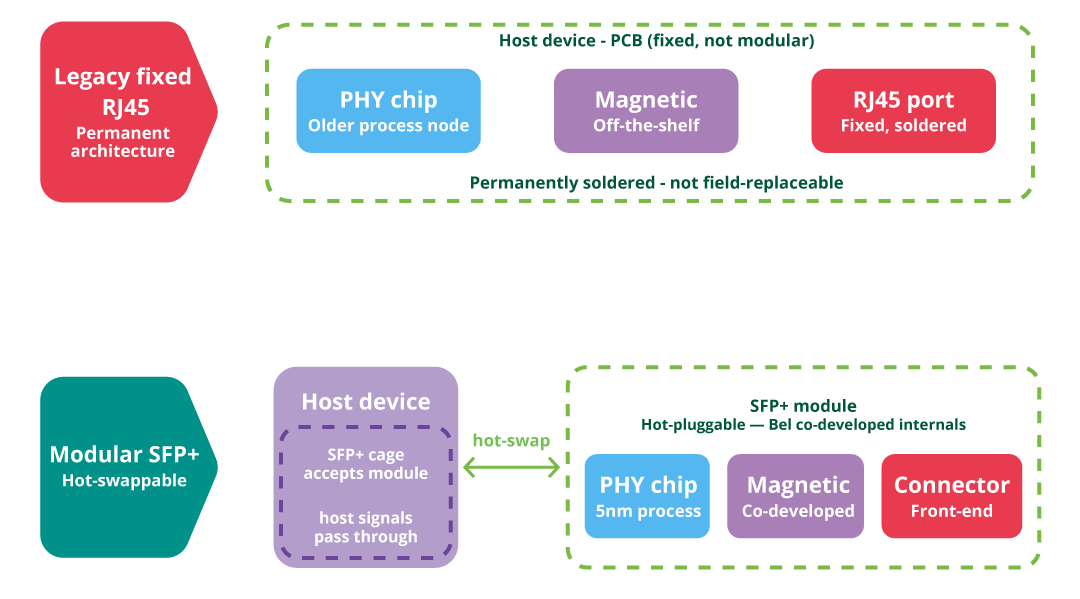
Before we can explore the challenge of SFP+ ports, it is important to understand the difference between traditional 10GBASE-T networking and 10GBASE-T SFP+ solutions.10GBASE-T refers to the IEEE 802.3an-2006 Ethernet standard that delivers 10Gbps networking over twisted-pair copper cabling terminated with RJ45 connectors. In these systems, the networking electronics are integrated directly into the host device and form a permanent part of the hardware (i.e. ports are fixed at the PCB level and cannot be modified). These connections are commonly found in domestic and commercial hardware that isn’t designed to be upgraded over time.
10GBASE-T SFP+: Swappable Transceivers for Copper and Fiber
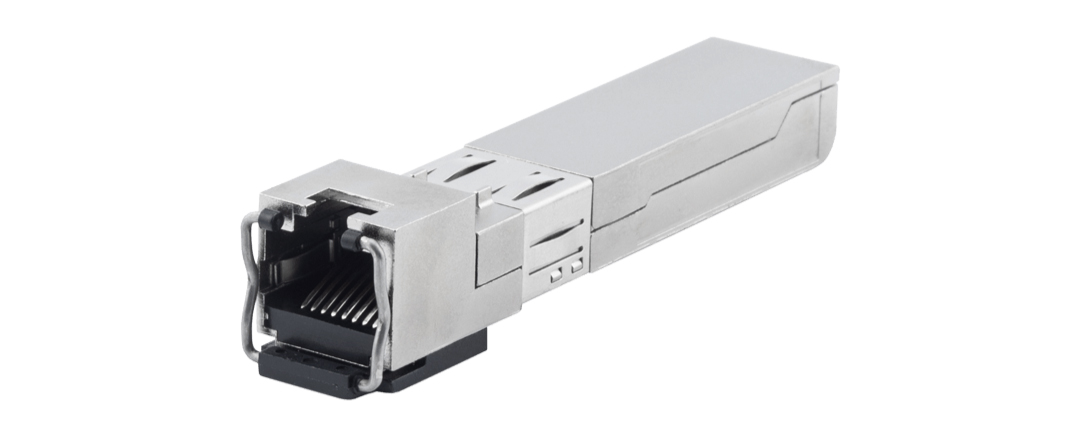
SFP+, however, takes a different approach. Instead of integrating networking hardware directly into a switch or server, SFP+ uses compact hot-swappable transceiver modules that can be installed, swapped, or removed as required. Simply put, SFP+ ports are essentially high-speed communication interfaces that allow networking functions such as the PHY, magnetics, and physical connector to be integrated into a removable transceiver module.
Under ideal conditions, this modular approach provides several serious advantages. For example, network equipment can be made to support both copper and fiber networking as it is the module that is responsible for converting signals to a digital data stream. Modular designs also allow for faulty transceivers that can be replaced without replacing the host system as well as allowing infrastructure to be upgraded more easily.
This distinction between 10GBASE-T and 10GBASE-T SFP+ is crucial as it explains why achieving 10Gbps over 100 meters becomes significantly more challenging when using the SFP+ form factor.
| 10GBASE-T (fixed RJ45) | 10GBASE-T SFP+ | |
|---|---|---|
| Architecture | Networking electronics integrated directly into the host device at the PCB level | PHY, magnetics, and connector integrated into a removable, hot-swappable transceiver module |
| Connector | Fixed RJ45 port | Modular SFP+ cage |
| Power constraints | Relatively relaxed | Tightly constrained |
| Media flexibility | Copper only | Copper or fiber |
| Replaceability | Faulty port requires replacing the host device or PCB | Faulty transceiver swapped in seconds without touching the host system |
| Upgrade path | Requires new hardware with updated fixed ports | Swap the transceiver module |
| Typical deployments | Desktops, workstations, consumer routers, commercial edge devices | Data center switches, enterprise servers, industrial networking, high-density racks |
Why 10GBASE-T SFP+ Transceivers Cap Out at 30 Meters
From a cabling perspective, CAT6a has no difficulty supporting 10Gbps over distances up to 100 meters, and this capability is built directly into the standard, being routinely achieved using traditional RJ45-based networking equipment.
Fixed-port solutions, commonly found in desktop workstations, enterprise routers, and commercial networking hardware, often have few constraints on power consumption and thermal management. Enterprise infrastructure, however, does not enjoy the same liberties.
Servers, industrial networking equipment, and data center switches heavily rely on SFP+ architectures, with such systems easily containing dozens of transceiver modules all operating simultaneously.
Power and Thermal Constraints Inside the SFP+ Form Factor
But because SFP+ modules have a defined form factor, they are extremely constrained in both physical size and power consumption. Thus, every additional watt of energy consumed is another watt of energy that needs to be dissipated, and this can become extremely tricky when packing 48 of these ports in a switch rack.
This is one of the prime reasons why fiber transceivers dominate long-distance SFP+ deployments, as optical solutions can deliver high bandwidth over substantial distances while maintaining relatively low power consumption. But when it comes to copper networking, the power challenge rapidly scales with increased operating bandwidth.
Maintaining signal integrity across twisted-pair copper cables at 10Gbps requires sophisticated signal processing, equalization, echo cancellation, and error correction. Each of these functions consumes significant power, with longer cable lengths requiring increasingly aggressive signal recovery and equalization techniques.
Engineering 10GBASE-T SFP+ to Reach 100 Meters
Achieving reliable 10GBASE-T communication across 100 meters cannot be accomplished by addressing any one of these limitations. It requires a holistic approach where every part of the signal chain is optimized and matched accordingly.
Recognizing the challenges of pushing 10Gbps through CAT6a cables using SFP+ ports, Bel has produced a unique solution that addresses two critical areas: the PHY and the magnetics.
To address the PHY challenge, Bel partnered with PHY manufacturers to develop a solution based on a modern 5nm process node. This advanced process node significantly improves energy efficiency while enabling more sophisticated signal processing capabilities within the limited power budget available to an SFP+ module.
The transceiver front end, also integrated in the PHY, was refined to reduce input capacitance and improve overall signal integrity while still retaining the same safety capabilities.
Solving the Magnetics Challenge for Lower Insertion Loss and Crosstalk
To address the magnetics challenge, Bel leveraged its decades of experience in magnetic component design to develop carefully matched magnetics. As magnetics influence insertion loss, impedance matching, return loss, and common-mode noise rejection, any improvements, even small ones, can have a substantial impact on overall link performance.
By co-developing the PHY and magnetics as a complete system, Bel created a balanced design that minimized insertion loss, reduced crosstalk, lowered return loss, and improved signal recovery. The result is a lower bit error rate and the ability to maintain full 10Gbps operation across the 100-meter distances originally envisioned by the CAT6a standard.
Benefits of 100-Meter 10GBASE-T SFP+ for Enterprise, Industrial, and Data Center Networks
The most significant advantage of the new SFP+ ports supporting 10Gbps over 100m is that existing CAT6a infrastructure can finally be utilized to its full potential within SFP+ environments.
Existing networking equipment utilizing SFP+ ports over CAT6a can now be upgraded simply by replacing transceiver modules with the new co-developed Bel ports. With the new ports, there is no need for expensive cable replacement projects or major infrastructure redesigns.
| Sector | Benefits |
|---|---|
| Enterprise & Offices | Faster backbones, higher‑capacity APs, no cable replacement |
| Industrial | Long cable runs, more PLCs/sensors, 10Gbps over existing wiring |
| Datacenters | Avoid fiber for 30m+ runs, lower cost, more flexibility |
| AI Infrastructure | High‑speed copper links for dense compute environments |
For offices and commercial environments, this enables faster networking backbones, higher-capacity wireless access points, and support for increasing numbers of connected users.
Industrial applications, however, can potentially benefit far more. Considering that long cable runs are common throughout manufacturing facilities and process plants, the new ports will finally allow industrial sites to fully utilize 10Gbps over 100 meters via CAT6a. This can allow for the support of more PLCs, sensors, monitoring stations, and wireless connection points.
Datacenters also stand to gain from this new SFP+ solution. Historically, deployments exceeding 30 meters often required fiber optic infrastructure where SFP+ was used. While fiber provides excellent performance, it introduces additional installation costs and complexity. Extending copper SFP+ solutions to 100 meters over CAT6a now gives network architects greater flexibility while potentially reducing deployment costs.
The hot-swappable nature of SFP+ remains another major advantage, as organizations can increase network speeds without replacing entire switches or rerunning cable, often requiring nothing more than swapping one transceiver module for another.
Finally, the big market that is already transforming the industry is AI, and again, the new Bel SFP+ ports can empower these installations. As demand for high-speed connectivity continues to grow, the ability to utilize existing copper cabling while maintaining full 10Gbps performance creates new design opportunities and deployment options.
10GBASE-T SFP+ at 100M Is Now Achievable: What Comes Next?
While CAT6a has always been capable of supporting 10Gbps communication across 100 meter distances, the networking industry's transition to SFP+ infrastructure introduced a challenge that many engineers viewed as impossible to overcome. But the limitation was never caused by the cable itself. Rather, it stemmed from the power, thermal, and signal integrity constraints imposed by compact hot-swappable transceiver modules.
The consequence of these constraints was that organizations were forced to choose between shorter cable runs, reduced bandwidth, or costly fiber deployments.
However, thanks to its close partnership with PHY manufacturers and years of experience in magnetics, Bel has demonstrated that full 10GBASE-T performance across 100 meters is achievable within the SFP+ form factor. The switch to newer process nodes combined with carefully matched magnetics reduces power consumption and increases bandwidth while minimizing losses and noise.
What This Means for Future Copper Network Upgrades
With this breakthrough, organizations can now extract greater value from existing CAT6a infrastructure while retaining all of the flexibility and serviceability benefits that SFP+ platforms provide.
For enterprise networks, industrial systems, offices, data centers, and emerging AI infrastructure, the ability to deliver full 10Gbps performance across existing copper cabling can significantly reduce deployment costs and simplify future upgrades.
But more importantly, it challenges one of the networking industry's longest-standing assumptions: that 10GBASE-T SFP+ modules must remain limited to short-distance applications.
As networking demands continue to increase, innovations that bridge the gap between existing infrastructure and next-generation bandwidth requirements will play an increasingly important role. Thus, Bel's 100-meter 10GBASE-T SFP+ solution is an excellent example of how, with the right combination of PHY technology and magnetic design, long-standing limitations can still be overcome.